Resources
Waste management: prevention over recycling Summary
At Munich Airport, waste and recyclables are generated in various areas, such as in the terminals, offices, and on construction sites. FMG organizes waste management efficiently and sustainably in accordance with the requirements of the German Waste Management and Product Recycling Act. The primary focus is on avoiding waste. In addition, we place great importance on separating waste materials by type as precisely as possible, which greatly simplifies recycling processes. Non-recyclable waste is sent for energy recovery at the Munich North Combined Heat and Power Plant, where it is used to generate district heating and electricity.
Despite the rise in passenger figures, the volume of waste and recyclables fell significantly in 2025. The primary reason for this is the decline in construction waste. To continue ensuring sustainable waste management, reducing the volume of waste remains a key task. Individual disposal concepts are being developed to take into account the varying conditions of resident customers and companies.
One example of success: The return and reuse system in place in the food and beverage outlets operated by Allresto recorded a very high exchange frequency in 2025, with 1,030 care bowls and care cups in circulation. Based on the 19,376 exchanges that were made, each bowl was used around 28 times and each cup around eight times on average. Since the beginning of the test phase in 2021, we have thus saved around five metric tones of waste and roughly 1.5 metric tons of CO₂e (CO₂ equivalent) up to 2025 in comparison with a single-use solution.
The increasing demands for responsible waste disposal and the need to conserve environmental resources require carefully thought-out solutions. A topical example is the «Closed-Loop» project, initiated together with Lufthansa, to separate PET bottles from on-board waste of category 1. We are running a pilot phase in which we are removing these recyclables systematically from on-board waste and sending them separately for recycling. On account of the special legal requirements governing on-board waste, this project constitutes an important step in returning recyclable plastics back to the materials cycle even under challenging conditions. The use of primary raw materials is thus reduced and the circular economy is tangibly strengthened at Munich Airport.
Water management: conserving natural resources Summary
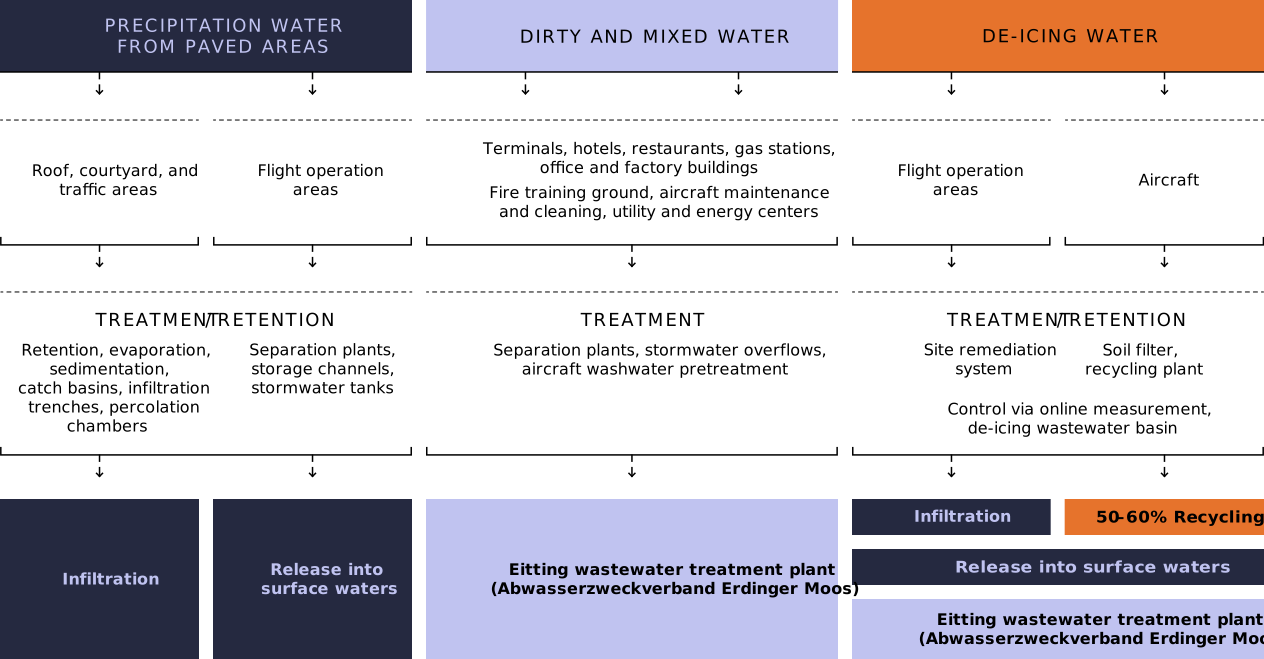
The aim of water management at Munich Airport is to affect the natural water balance as little as possible and to minimize any adverse effects caused by water management, drainage, and drinking and firefighting water supplies.
Use of process water reduces drinking water consumption
At 1.03 million cubic meters, annual drinking water consumption at Munich Airport is roughly equivalent to that of a city of 22,000 people. The quality of the water is regularly examined at various points in the supply network.
Where drinking water quality is not required, we increasingly use process water: for concrete work and construction site spraying, runway cleaning, sweeper operations, sewer cleaning, and the irrigation of green areas, shrubs, and trees. Additionally, instead of using tertiary groundwater (drinking water), near-surface quaternary groundwater (process water) from a specially drilled well is used for cooling the West Power Station. Since process water pumping began in 2010, the total savings add up to around 3.26 million cubic meters.
Recycling of aircraft de-icing agents
De-icing vehicles keep aircraft free from ice and snow before take-off. The de-icer dripping off the aircraft during this process finds its way via slit drainage gutters and channels into underground basins. At the recycling plant at Munich Airport, it is treated mechanically and chemically to recover type 1 de-icing agents. During the 2024/2025 winter season, the recycling rate was 47.4 percent. It ranges between 40 and 60 percent and depends on the amount of de-icing agent used, but also heavily on weather conditions, particularly temperature, precipitation, and evaporation.
Win-win situation: pickle brine for de-icing
Following a positive test run, pickle brine was used to de-ice roads in the public area on the airport grounds during the 2025/2026 winter season. All parties benefit from this sustainable winter service concept: brine from the pickle production of the Develey company in Dingolfing no longer needs to undergo elaborate disposal processes there but will instead help to clear roads of snow and ice at the airport. This reduces the amount of road salt released into the environment.