Biodiversity
Three-zone concept: creating valuable habitats Summary
To integrate Munich Airport into its environment in the best possible way, FMG created structures from the very outset that would ecologically upgrade the extensive surrounding area in the Erdinger and Freisinger Moos and link it together. For this purpose, a three-zone concept was implemented within the framework of the current green regulations: Zone I comprises the airport premises with runway system, buildings and roads, Zone II the wooded and structurally rich green belt around the airport premises and Zone III the ecological compensation measures.
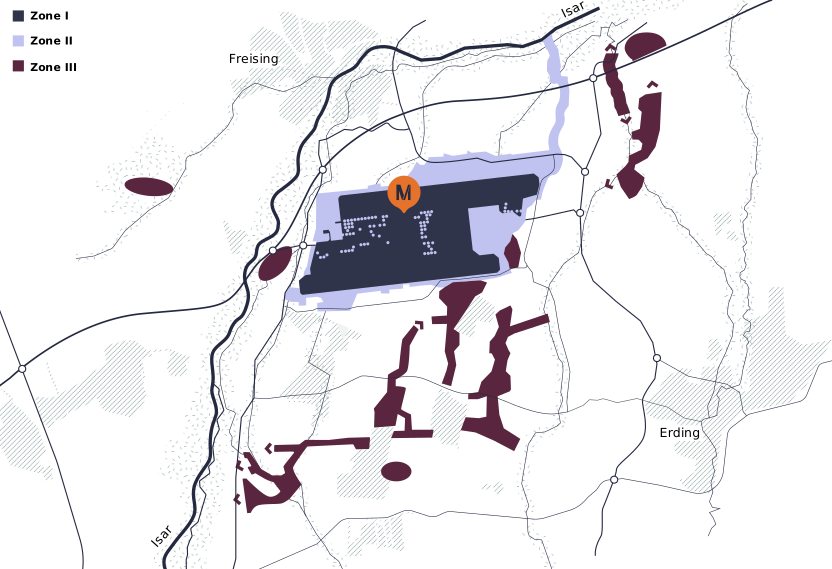
Zone I: airport grounds with runway system, buildings, and roads
Green areas, with currently around 5,000 planted trees, cover roughly more than half of the airport grounds. Through continual maintenance, species-rich vegetation and ecologically valuable habitats, especially for rare meadow breeders, have been created notably within the security fence and on the green areas between the runways and their infrastructure facilities.
Zone II: green belt rich in woodlands and structures around the airport grounds
The airport perimeter zone, with its woodlands, drainage ditches, and meadows, functions as a buffer in the transition zone approaching residential areas and farmland. The northern pre-flood ditch with its near-natural course is home to protected plants such as pasqueflower, ox-eye daisy, perennial, and bellflower. The list of specially protected species includes the marsh gladiolus and the variegated pondweed.
Zone III: ecological compensation measures
To date, FMG has planned and created around 530 hectares of compensation areas. They serve to compensate for the impact on nature and the landscape caused by construction projects. The responsible approval authorities confirmed that they were produced and maintained in accordance with the requirements. These nature conservation compensation areas contribute significantly to the region’s biodiversity with their richly structured and species-rich vegetation. They are distributed across the agricultural land and form retreats and stepping stones in the biotope network. They are neither fertilized nor treated with pesticides.
Compensating measures: on the campus and in the surrounding area
To compensate for the new photovoltaic system south of parking garage P51, we began work in late fall 2025 on the creation of an area west of the airport grounds that is intended to offset the loss of vegetation and a gray partridge habitat. Two lizard habitats have been created in the immediate vicinity of the new photovoltaic system, for example. Moreover, a row of trees including 18 climate-resilient linden trees has been planted south of the viewing hill.
Bird sanctuary: a home to endangered bird species
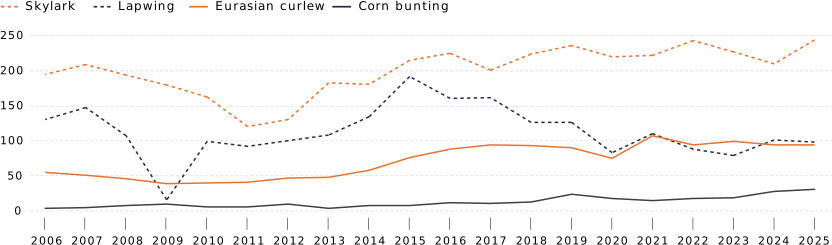
In August 2008, the 4,525-hectare EU bird sanctuary «Northern Erdinger Moos» was designated. Its centerpiece is the approximately 666-hectare area of airport meadows surrounding the two runways. In 2025, these meadows, as Bavaria’s most important breeding area for meadow birds, hosted 94 breeding pairs of the Eurasian curlew and 98 breeding territories of the lapwing. The critically endangered black-tailed godwit, of which only 16 breeding pairs remained across Bavaria in 2025, has also repeatedly bred on the airport meadows. In total, 40 bird species, some of them critically endangered, benefit from the high level of protection on and around Munich Airport grounds. Furthermore, in conjunction with the compensatory and replacement areas outside the airport premises, the airport serves as a refuge for rare plant species such as the creeping celery, reptiles such as the sand lizard, and insects such as the bird’s-eye damselfly.
«Bird life and flight operations» brochure
Bird sanctuary - Munich Airport
Ecological commitment: «Blooming Business»
The airport was once again honored as a «Blühender Betrieb» («Blooming Business») in 2025. The requirements for this stipulate, among other things, that at least 20 percent of the open spaces on the company grounds are designed to be insect-friendly and near-natural, a consistent food supply offered by flowers is available from spring to fall, flower pastures are left uncut over the winter, and no chemical plant protection products are used. The award underlines Munich Airport’s commitment to promoting biodiversity and habitats for insects, starting from the ecologically highly valuable nutrient-poor grasslands with their colorful diversity around the runways and extending to various nature conservation and biodiversity projects. The establishment of six insect hotels on the airport grounds and the sowing of the species-rich flower meadows at the southern viewing hill in 2023 are examples of this.