Climate protection
CO₂ savings: our path to Net Zero Summary
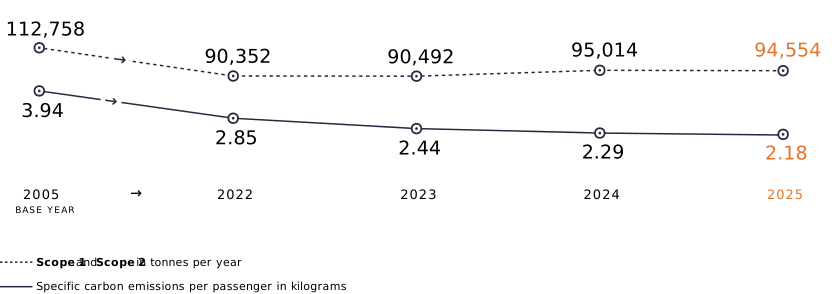
At 94,554 metric tons, CO₂ emissions (scope 1 and 2) attributable to Munich Airport were at roughly the same level in 2025 as in the previous year (-460 metric tons) – even though the heating requirements in the cold months at the start and the end of the year increased by 12 percent compared with 2024. This resulted in higher gas consumption in the block heat and power plants and gas-fired boilers providing heat for the district heating system. The growth in passenger numbers by more than four percent in comparison with the previous year also contributed to the higher demand for energy.
That the CO₂ emissions fell slightly despite these effects shows the effectiveness of the measures that have been implemented: Munich Airport invested almost 1.5 million euros in a further 18 energy efficiency measures in 2025. We achieved the largest savings in the area of mobility, followed by ventilation and air conditioning. In total, the annually recurring CO₂ savings made as a result of this amount to approximately 4,400 metric tons. Over the long term, CO₂ emissions have fallen by more than 65,000 metric tons of CO₂ per year since 2005 with 388 measures now implemented. This is clearly visible for example in the consumption of gasoline and diesel, which declined by more than 1.3 million liters from 2019 to 2025, equivalent to a reduction of approximately 27 percent.
With the rise in passenger numbers, specific CO₂ emissions per passenger fell further to 2.18 kilograms (scope 1 and 2) in 2025. Compared to the 2005 baseline of 3.94 kilograms, this represents a reduction of approximately 45 percent.
CO₂ footprint: a complex math problem Summary
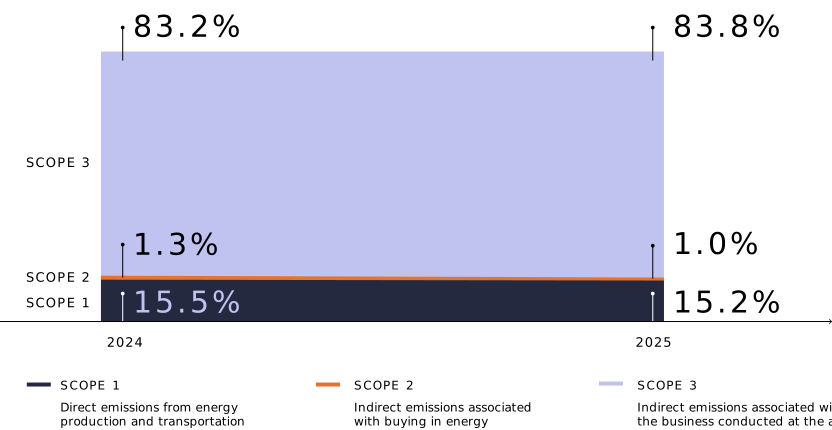
The operation of a large infrastructure facility involves emissions from a wide variety of polluters. They are all included in the balancing of an airport’s greenhouse gas emissions. Emissions from air traffic in the landing-and-take-off cycle (aircraft landing and taking off at altitudes up to 3,000 feet) account for the largest share. The CO₂ footprint provides the basis for recording all forms of emissions and lends itself to comparison. It breaks down all greenhouse gas emissions that can be attributed to the airport into three different sources (scopes) according to an international standard, the «Greenhouse Gas Protocol».
Scope 1 and Scope 2
Energy concept: multiple solution approaches
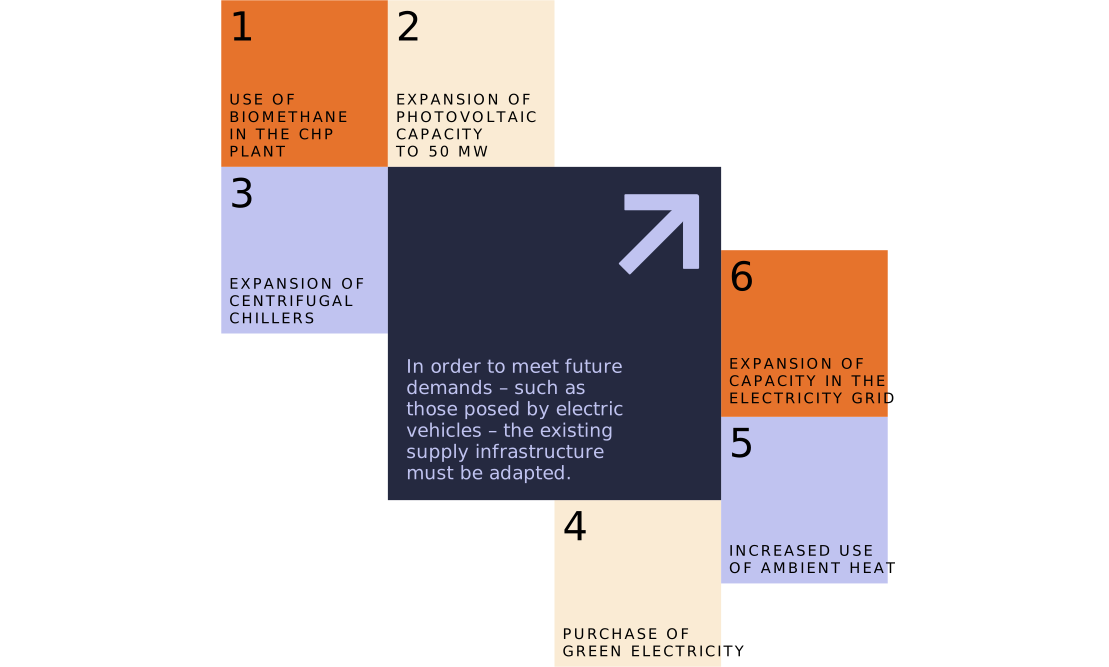
A key role on the path to a CO₂-free future is played by the sustainable provision of electricity, heat and cooling through the expansion of renewable energies. In the future, Munich Airport wants to use as many available resources in the region as possible for its energy supply, such as photovoltaics. In addition to climate protection, high energy prices and the need to avoid any dependence on imported natural gas are strong arguments for promoting energy supply autonomy.
1 Biomethane
The conversion of the airport’s own combined heat and power plant to externally sourced biomethane as part of the Net Zero Strategy represents an important building block in achieving our CO₂ reduction targets. We are currently in the final planning phase of the overall concept.
2 Photovoltaics
Photovoltaic systems with a total output of 50 megawatts (MW) are set to go into operation on parking garages, freight buildings, and suitable open spaces by 2030. In sum, photovoltaic systems with a total output of seven megawatts peak (MWp) had been installed on Munich Airport’s grounds as at the end of 2025. They produce a total of just under seven gigawatt-hours of solar power per year. Meanwhile, the first photovoltaic system on open space on the campus – including battery storage – is being erected on a meadow next to the administrative building. It will produce electricity over the course of 2026 and ultimately contribute output of 3.7 megawatts peak. Several other photovoltaic systems are being installed.
Goal: expansion of photovoltaic systems
20 MW on roof areas
30 MW on open areas
Over 50,000 MWh of solar power
Equivalent to the electricity consumption of almost 15,000 households or a quarter of Munich Airport’s electricity consumption in the pre-crisis year 2019
Over 19,000 tons of CO₂ savings per year
3 Centrifugal chillers
We expanded the cooling generation capacity by 20 MW in the east power station. This measure is helping to improve security of supply and reduce CO₂ emissions. The new systems will enable increased electrical cooling generation – especially in the summer months and in combination with the airport’s own photovoltaic systems. They will gradually relieve the load on the existing absorption chiller systems, which will in turn reduce the operating hours of the gas-fired block heat and power plant. The shift of cooling generation to efficient, electricity-based systems will reduce both gas consumption and the related CO₂ emissions. The project will thus play an important part in achieving the net zero targets at Munich Airport.
4 Green electricity
Following an EU-wide call for tenders, Munich Airport entered into a long-term electricity supply contract for the delivery of wind power to further increase the volume of renewable energies in its existing energy mix. The contract was awarded to RWE Supply & Trading GmbH, which currently has an offshore wind farm under construction in the North Sea. In the present phase, offshore wind power is better suited for Munich Airport than onshore wind power, as lower fluctuations in electricity generation and thus in electricity procurement make it easier to integrate this green electricity in our energy systems.
5 Increased use of ambient heat
In 2025, we worked together with an external partner on a strategic project to remodel our energy supply. We created a dynamic digital twin, which we used to develop the most economic and reliable variant of our energy supply – always keeping in mind the aim of achieving the net zero target. The results show that the use of ambient heat based on industrial-scale heat pumps (electrification of the energy supply) – backed up by renewable gas for peak loads in the winter – is not only possible and economic, but also makes sense.
6 Expansion of capacity in the electricity grid
The planning of the «3rd Electricity Grid» project, with a total investment volume of 246 million euros, is almost complete. The first calls for tenders for construction works and material supplies will be issued in 2026. The start of construction is planned for 2027, with completion scheduled for the end of 2029. The project also includes the construction of an additional transformer station. Overall, the electricity transmission capacity at Munich Airport, especially for self-generated photovoltaic electricity as well as for charging infrastructure, will more than double as a result.
Top 3 Measures
Electrification of ground handling vehicles increases once again
Munich Airport generated the largest CO₂ savings – at 2,470 metric tons – in the area of mobility. AeroGround, the FMG subsidiary responsible for passenger and crew transport, replaced a total of 83 vehicles – including 27 buses, 16 towing vehicles and 20 ground power units (GPUs), which now have electric drive systems – and thus saved 2,099 metric tons of CO₂ alone. More than 200,000 liters of diesel per year will be saved just by the GPUs.
Optimization of the ventilation systems
As in previous years, the optimization of the ventilation systems is continuing and produced the second largest CO₂ savings in 2025. The upgrading of the ventilation units in the connecting tunnels can be highlighted in particular here. In addition to the conversion to new ventilation technology, the control system was also optimized, which will save more than 500 megawatt-hours of electricity per year. But other systems were also upgraded and optimized in Terminal 1, Terminal 2, and in the T2 satellite.
LEDs reduce energy consumption
One of the five biggest energy efficiency measures in the area of lighting was the conversion of the super signs. The ultra-large «M» signs on the approach roads to Munich Airport are illuminated in a new light. Together with intelligent controls, this will reduce electricity consumption by approximately 160,000 kWh per year.
Electromobility: major contributor to CO₂ savings
Munich Airport has already tested various alternative drive concepts. These include the opening of the world’s first public hydrogen filling station in 1999 as well as trials with biogas, bioethanol, biodiesel and C.A.R.E. diesel (C.A.R.E. stands for CO₂ Reduction, Arctic Grade, Renewable, Emission Reduction). As at the end of 2025, we operate 225 passenger cars and small transporters as well as 464 ground handling and specialized vehicles, i.e. around half of the vehicle fleet, with electric drive systems. The vehicles category thus contributes approximately 26 percent to our total CO₂ savings. Over 90 percent of our vehicles will be fitted with alternative drive systems by 2030.
Electric drives are especially efficient for apron operations, where a lot of short distances are covered at low speed. AeroGround is investing up to 60 million euros for this. The project will be assisted with a subsidy of just under 24 million euros from the Federal Ministry of Transport. AeroGround has deployed a fleet of 55 zero-emission buses since 2025. This will be expanded to up to 72 vehicles based on actual requirements and in line with the development of the charging infrastructure. We created the basis for fully electrified apron operations with a new bus depot in 2025. It has 50 charging points for passenger buses. An expansion phase with a further 22 charging stations including carports with photovoltaic systems is planned for 2026 and 2027.
Another building block in the implementation of the sustainability strategy was the opening of Bavaria’s largest charging station for electric cars in parking garage P44 in september 2025. With 275 charging points, the facility is also one of the largest public charging stations in Germany. The solar electricity is generated by two photovoltaic systems on the roofs of parking garage P44 and the adjacent parking garage P43. A total of 7,216 photovoltaic modules were installed for this purpose. Overall, the modules produce a maximum output of three megawatts – roughly equivalent to the average demand of 1,000 three-person households. FMG has so far invested around 5.2 million euros from its own funds in the project, which is being implemented in cooperation with other regional companies. To date, we have installed over 600 charging points for both our own pool vehicles as well as for airlines, authorities, the rental car and car-sharing sector, air travelers, and some ground handling equipment. The plan is to expand the existing charging infrastructure by several thousand charging points by 2030. More than 1,000 standard charging points and twenty fast-charging points are planned to be newly installed in the public area alone.
Not all vehicles can be switched to electric drive systems in the foreseeable future either because the technology is not available or for reasons of economic sustainability. We are currently focusing on the use of HVO100 (hydrotreated vegetable oil) fuel produced from biological residues and waste as a bridging technology for the diesel vehicles in question. The gradual introduction of the synthetic fuel will enable us to prevent up to 90 percent of the CO₂ emissions from our diesel vehicles.
Scope 3
Photovoltaics for Lufthansa
A photovoltaic system with 145 kWp was installed on the roof of the new engine maintenance facility for Lufthansa during its construction. The full feed-in system is connected to FMG’s electricity grid. It will generate approximately 150 MWh of electricity and save around 55 metric tons of CO₂ per year.
Air quality: consistent monitoring Summary
Nitrogen oxides and particulate matter: at a low level
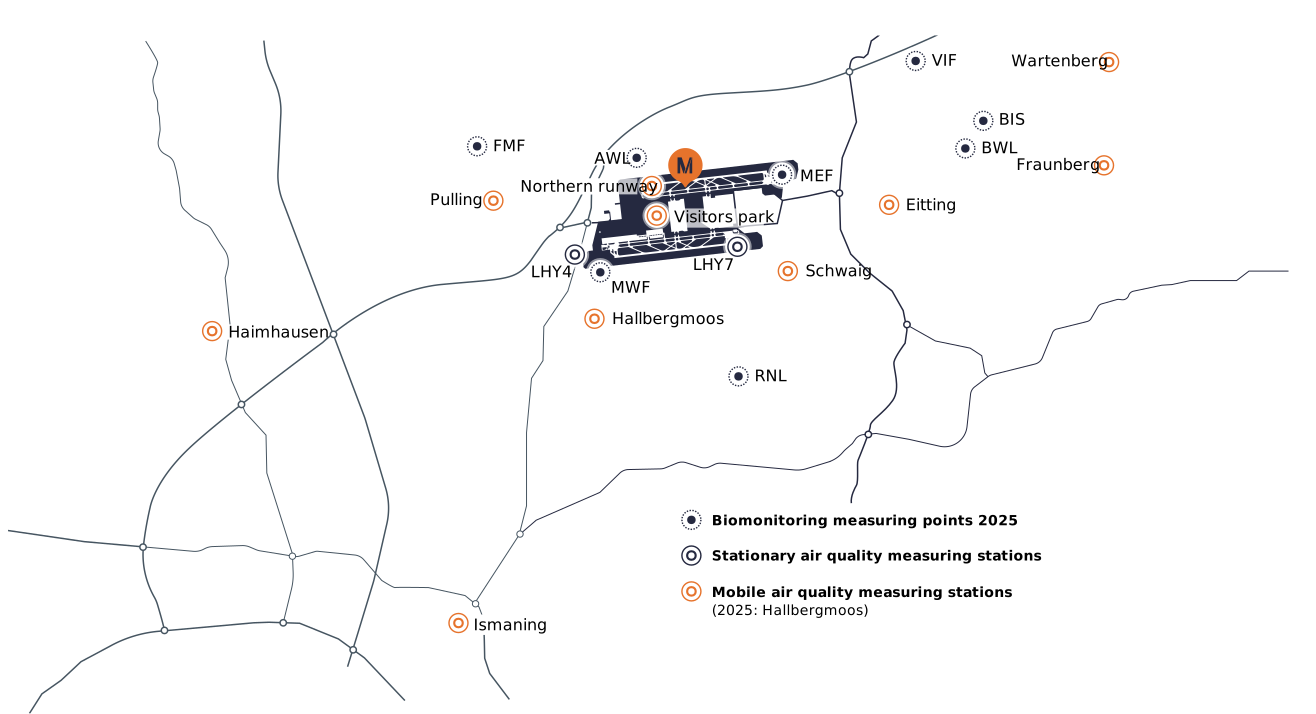
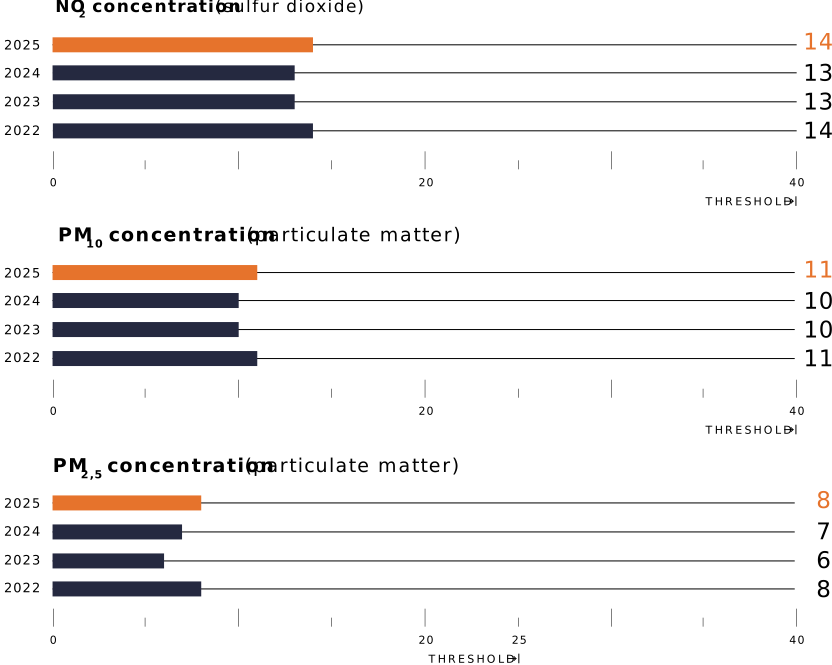
As with CO₂, aircraft cause significantly more air pollutant emissions than ground traffic on the aprons and on access and service roads. It is not possible to differentiate between the emissions by metrological means, however. Nitrogen oxides and particulate matter are key factors in assessing air quality at the airport and in its environs. For the measurement of air pollutants, we operate one mobile and two stationary measuring stations. The stationary measuring stations in the west and east of the airport record the effects of pollutant sources from road and air traffic and other airport operations – superimposed on the background pollution of the Munich metropolitan area and the natural background concentration in the atmosphere. The mobile air quality measuring station is used to analyze air quality in the areas requested by various municipalities. Mobile measurements were again taken in Hallbergmoos in 2025.
In 2025, the nitrogen dioxide concentrations at Munich Airport remained at a normal level for a suburban area. The concentrations of particulate matter at Munich Airport are at a consistently low level and are characteristic of rural areas. Here we can see a clear meteorological dependency: Dry and hot weather favors higher levels of particulate matter. In 2025, all air quality monitoring stations recorded levels well below the applicable legal limits.
Annual average values in microgram/m³
Landing charges: emissions as the basis
FMG charges emissions-based landing charges. Our aim is to motivate engine manufacturers and aircraft builders to invest more in the development of aircraft that produce less in the way of pollutant emissions. Munich Airport is thus helping to better environmental quality in the surrounding area. Based on the types of aircraft that land, we are able to calculate pollutant emissions – as well as the greenhouse gas CO₂ – down to the individual engine and directly reflect technological progress.
Ultrafine particulate matter: a further topic of research
Air traffic is a source of ultrafine particles (UFPs). However, there is currently no objective standard for assessing particle concentrations and no limit values. The University of Bayreuth has been measuring the UFP concentration in the vicinity of Munich Airport in Freising and Hallbergmoos since the spring of 2021 on behalf of the Bavarian Ministry of the Environment. The results are published regularly on the ministry’s website. Consequently, the concentrations in Freising and Hallbergmoos are at a similar level to those at the measuring stations of the Bavarian State Office for the Environment in Regensburg, Augsburg, and Munich. FMG supports the University of Bayreuth’s measurements with the mobile measuring station at the Hallbergmoos site and collects additional air quality parameters to help interpret the UFP concentrations. FMG does not carry out UFP measurements itself.
Organic honey: more than 40 bee colonies around the airport
Long-lasting pollutants can accumulate in the environment and therefore seep into the food chain. Munich Airport has been monitoring this situation for many years using a variety of methods. In 2025, plant pots with perennial ryegrass and kale were installed at eight measuring points in the surrounding area in order to investigate the contamination of feed and food in the area around the airport. No abnormalities were found. We also continued our honey monitoring efforts involving more than 40 bee colonies around the airport. Munich Airport honey has been certified «organic» since 2023. It is the first honey from a German airport to meet the requirements of the EU Organic Regulation VO(EU) 2018/848 and bears both the EU organic label and the German organic label on its packaging.