Situation of the Group
Business model of the Group Summary
Situation
Flughafen München GmbH (FMG) is headquartered in Munich. As the senior parent company of the Munich Airport Group (Munich Airport), it is the operator of Munich’s passenger airport.
Munich Airport is active via the business units Aviation, Commercial Activities, Real Estate and Participations, Services & External Business. The Group’s service profile covers virtually all the services available on the airport campus – from flight operations and passenger handling through to retailing, hotels, and gastronomy. This integrated business model sets Munich Airport apart from many international competitors.
Munich Airport is committed to a corporate policy of sustainability. The orientation toward economic, environmental, and social goals ensures that the airport gains acceptance and enables it to continue its ongoing development.
Main features of management and control
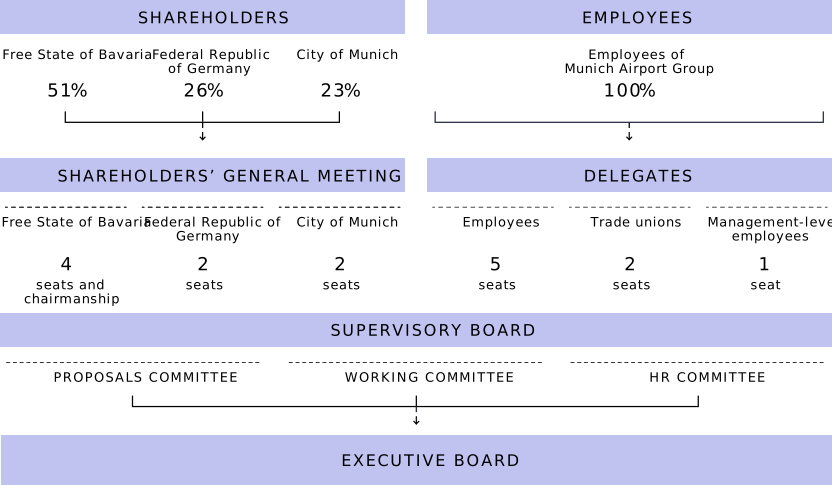
The shareholders of FMG are the Free State of Bavaria with a 51.0% stake, the Federal Republic of Germany with a 26.0% stake, and the City of Munich with a 23.0% stake.
According to section 5 of FMG’s Articles of Association, its executive bodies consist of the Executive Board, the Supervisory Board and the Shareholders’ General Meeting.
Executive Board
As a rule, the members of FMG’s Executive Board are appointed for five years. Re-appointments are permitted. The Executive Board consists of three members (including the Chairman of the Board), represents FMG externally and is responsible for corporate policy and the strategic direction of the Munich Airport.
The members of FMG’s Executive Board receive a fixed salary and performance-related remuneration with short and medium-term incentives (bonus). The bonus is primarily linked to the earnings before taxes.
Supervisory Board
FMG has a Supervisory Board pursuant to Sections 1 (1) and (6) of the German Codetermination Act [Mitbestimmungsgesetz – MitbestG]. The Supervisory Board exercises monitoring and co-determination rights. It appoints members of the Executive Board and determines their remuneration. Transactions exceeding certain thresholds or terms require Supervisory Board approval. The employee representatives on the Supervisory Board are elected by Munich Airport’s employees every five years. The shareholder representatives are appointed by the shareholders’ general meeting. The term of office of the Supervisory Board members ends at the Shareholders’ General Meeting that adopts a resolution on granting formal approval of the actions of the members for the fourth fiscal year after they start their term of office; the current term is expected to end in June 2029.
The Supervisory Board has appointed a proposals committee, a working committee and an HR committee, and it has entrusted them with the following tasks, among others:
Proposals committee | Fulfillment of tasks pursuant to Section 31 (3) of the German Codetermination Act (MitbestG) |
Working committee | Comments for draft resolutions that require the approval of the Supervisory Board; approval in lieu of the Supervisory Board for certain legal transactions that exceed fixed value limits or terms |
HR committee | Drafts the contracts of the Executive Board (excluding remuneration), the fully authorized representatives and the authorized signatories; approves the definition of and amendments to the remuneration rules outside of collective agreements; approves the introduction of and changes to salary levels of certain employees and the introduction of and changes to company pension benefits. |
Shareholders’ General Meeting
The Shareholders’ General Meeting is the highest monitoring and decision-making body. Central decisions on the business and economic fundamentals of the Group (including airport expansion and the borrowing of loans) must be adopted unanimously.
Group declaration on corporate governance – Information about the proportion of women
In the context of ensuring the equal participation of women and men, the Supervisory Board and Executive Board of the parent company FMG stipulate targets and deadlines for the proportion of women on the Supervisory Board, Executive Board, and on the first two management levels.
A ratio of 25% has been set for the proportion of women on the Supervisory Board by June 30, 2029. The employee representatives on the Supervisory Board are elected, while the shareholder representatives are primarily appointed based on specific functions to be performed. In this respect, the possibility of directly influencing the proportion of women on the Supervisory Board is limited.
A target level of 33% has been set for the proportion of women on the Executive Board by June 30, 2029.
The targets that have been adopted up to June 30, 2029 stipulate that women should make up 30% of the executives in the first management level and 35% in the second-highest management level.
Activities
Organizational structure
Munich Airport’s organizational structure is divided into FMG’s business, service, and corporate divisions. The management and internal reporting of the business units is primarily handled by FMG’s group management. The business units shown in the figure comprise the business and service divisions of FMG and the Group companies integrated in the business units. The business units are explained in the following sections.
Business, service, and corporate divisions FMG (as of December 31, 2025)
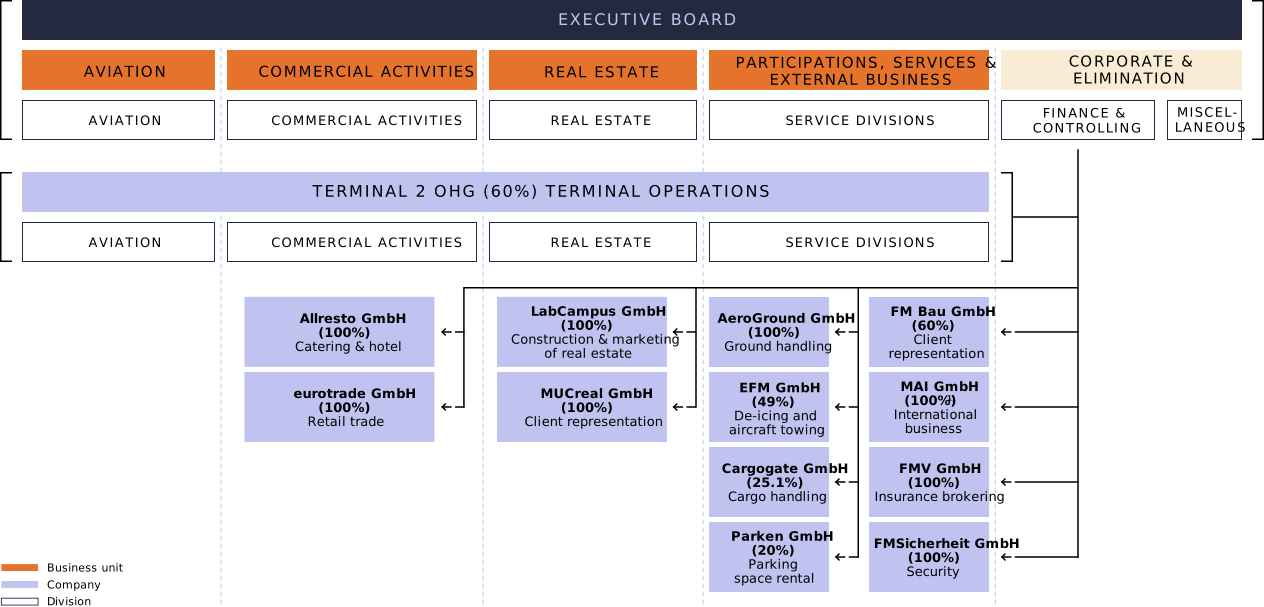
Munich Airport International GmbH holds a 100% equity interest in Munich Airport US Holding LLC and amd.sigma strategic airport development GmbH as well as a 50% equity interest in ORAT AMS Group V.O.F. Munich Airport US Holding LLC in turn has a 100% equity interest in Munich Airport NJ LLC.
A total of 74.9% of the shares in Cargogate Munich Airport GmbH, Hallbergmoos, were sold with effect from January 2, 2025. In addition, all of the shares in aerogate München Gesellschaft für Luftverkehrsabfertigungen mbH, Oberding, were sold with effect from April 1, 2025. A detailed overview of the ownership structure is included in the notes to the consolidated financial statements.
As of December 31, 2025, the Group comprises the parent company, a total of 12 fully consolidated companies, two associates, one joint operation, and two companies that are not consolidated.
Aviation business unit
Infrastructure for airlines and passengers
The Aviation business unit covers the operation of Munich Airport’s air traffic infrastructure.
Munich Airport operates two runways with a maximum capacity of 90 aircraft movements per hour during daytime operations at normal capacity. As a general rule, between 10 p.m. and 6 a.m., flight operations are only permitted to a very limited extent and only with particularly low-noise aircraft. Flights are not allowed between 12 midnight and 5 a.m., with the exception of emergency and medical aid flights, landings required for reasons of air safety, as well as flights in justified exceptional cases that are approved by the Bavarian Ministry of Housing, Building, and Transport as the competent authority.
The Aviation division of FMG is responsible for operating Terminal 1 at Munich Airport, while Terminal 2 is operated by Terminal 2 Gesellschaft mbH & Co oHG – a partnership between FMG and Deutsche Lufthansa AG (hereinafter referred to as Deutsche Lufthansa or Lufthansa). Both terminals will be continuously optimized and expanded as needed.
The T1 pier at Terminal 1 is designed to facilitate further growth and to meet the future requirements for efficient security checks and terminal infrastructure, thus enabling Munich Airport to maintain and improve its status as a premium hub with a corresponding quality of stay. It was commissioned in April 2026 after trial operations had been run and in accordance with operational matters.
Munich Airport levies various charges for providing and operating these air traffic facilities. The framework agreement on charges (ERV), which went into effect in the 2021 fiscal year, generally sets out the development of air traffic charges up to and including 2030 and ensures the refinancing of infrastructure to a defined extent. In 2025, charges increased by 5.2% on average, as per the ERV.
Munich Airport is strategically well positioned thanks to its central location in Europe in the middle of the Munich metropolitan region, which is characterized as a center of innovation, knowledge and business with a broad-based industry structure. In the Prognos Zukunftsatlas 2025 («Future Atlas»), Munich occupies third place in the overall standings, while the research company forecasts «best prospects for the future» for the city of Munich and the Munich administrative district1). While international hub traffic already made a welcome return in the summer of 2022, the recovery in air traffic can now also be seen in the other traffic segments. Hampered by high location costs, especially the aviation tax and the disproportionately high impact it is having, and by a reduced offer, German domestic traffic is acting as a brake on this development, which is further reducing the range of services offered. The demographic and general economic conditions in Bavaria and especially in the airport catchment area suggest that transportation demand at Munich Airport will continue to grow in the medium to long term. Further comments on this topic can be found in the section «Economic environment».
Over the years, Munich Airport has developed into a major air traffic hub in cooperation with Deutsche Lufthansa. Jointly supported expansion measures such as Terminal 2 and the satellite building, as well as the on-going stationing of Lufthansa’s Airbus A350 long-haul fleet in Munich, are the foundations of a sustainable partnership that stands for long-term growth. A total of 35 aircraft from the Lufthansa Group’s long-haul fleet were stationed in Munich for the 2025 summer timetable (previous year: 32).
Thanks to its promising market position and successful cooperation with Lufthansa, Munich Airport had one of the most extensive networks of intercontinental connections in Europe, measured by the number of destinations.
The combination of a dense network of German domestic and European links and strong local demand means that Munich Airport can once again offer an attractive portfolio of long-haul flights. Due to the attractiveness of the location for tourists and the growing catchment area with an affluent population, Munich Airport has also become an attractive location for point-to-point connections.
The very high location costs in Germany and protectionist measures – particularly the lack of traffic rights – continue to hamper market-driven growth at Munich Airport, however.
Cargo handling at Munich Airport is heavily dependent on the development of passenger traffic. The reason for this is that the majority of airfreight at Munich Airport – 89% in the 2025 reporting year – is normally transported as bellyhold cargo on passenger flights, in particular on long-haul routes. Globally, however, the share of airfreight volume accounted for by bellyhold cargo is only around 55%2).
Commercial Activities business unit
Customer-specific services and promotions along the passenger journey
The Commercial Activities business unit is responsible for developing, marketing and managing all space throughout Munich Airport that may be used for commercial purposes.
This includes supplying demand-oriented parking space capacities. At present, there are approximately 36,700 parking spaces, of which some 20,900 are close to the terminal. In addition to regular passenger parking, the product portfolio also includes the rental car business, premium parking and tenant parking, as well as landside transfer operations.
It is also responsible in the Commercial Activities business unit for strategically planning the sector mix with regard to the retail, service, and gastronomy space, as well as for leasing and granting concessions to third parties and Group companies.
Munich Airport maintains approximately 18,700 m² of gastronomy space (previous year: 19,300 m²) and some 21,000 m² of retail and service space (previous year: 19,700 m²). FMG subsidiaries operate their own retail or gastronomy businesses on approximately 74% of the total area.
Commercial Activities is also responsible for the 5-star hotel in Munich Airport’s central area. It has 550 rooms and 30 conference rooms.
Commercial Activities also markets the advertising media and spaces at Munich Airport. The offer of what is known as out-of-home advertising at Munich Airport is characterized by high-profile advertising spaces with little wastage, which are tailored to clients’ individual requirements.
The business unit’s service portfolio also includes the event business.
Real Estate business unit
Real estate location with attractive appeal
The Real Estate business unit develops, operates, and markets all real estate and property owned by Munich Airport, both on and off-campus. The real estate location is divided into location-specific areas, which are marketed under the AirSite concept. Munich Airport has a lot to offer as a real estate location: an attractive environment, good road connections, extensive parking and a comprehensive range of goods and services for daily needs.
In accordance with the high demands placed on the entire area, an urban planning concept was developed that is continuously updated and the implementation of which is already visible and partly already in operation with the construction of the first high-rise buildings.
Participations, Services & External Business business unit
Participations & External Business: Full-Service-Provider
The other companies in the Group round off the range of services offered by Munich Airport. The most significant subsidiaries are:
AeroGround | AeroGround Flughafen München GmbH (AE) provides ground handling services for airlines on site. The key business units include airside aircraft and baggage handling, transport services for passengers and crew, the operation of the facilities of the airport’s core infrastructure, and handling services in the area of general aviation. |
MAI | Munich Airport International GmbH and its affiliates provide management, consulting, and training services for the aviation industry worldwide. |
Services: Energy, IT, and digital for all tenants at the airport
Alongside the business units and subsidiaries, the service divisions are also involved in external sales. The largest contribution comes from the following service divisions:
Technology | The service division is responsible for the secure and economical technical operation of the airport infrastructure. Among other things, this includes the supply of energy, maintenance of buildings and airport-specific equipment, as well as vehicle management. In addition, this division plays a key role in implementing Munich Airport’s CO2 strategy as part of its energy supply, energy savings and energy management activities. |
IT and digital | The service division is the main IT provider for Munich Airport. It provides modern, reliable and integrated solutions for increasingly process- and data-supported airport operations. The IT service portfolio comprises various services in media and communications technology, workplace IT equipment, and server, database, and storage system technology. The division’s core competencies lie in the integration of different technical IT platforms and the provision of customized technical system solutions to support logistics processes at Munich Airport. As part of the digital transformation, the service division actively supports change processes for the further or new development of digital business models. Compliance with security and data protection requirements and Group-wide uniform standards is gaining in importance. |
The activities in the Participations, Services & External Business unit (excluding handling services) account for a small share of Munich Airport’s external revenue, and a detailed explanation is therefore not provided in the section «Economic environment». Developments relating to handling services in the Group have been included in the passages on «Aviation business».
Control system and values management Summary
Munich Airport measures the performance of its managers with the help of material financial and non-financial key figures. Earnings before taxes (EBT) covers the financial perspective. Non-financial key figures include CO₂ reductions, the Passenger Experience Index (PEI), and Lost Time Incident Frequency (LTIF).
Earnings before taxes (EBT)
Earnings targets for managers are formulated on the basis of EBT.
EBT is the input factor for determining profitability. It relates to the consolidated earnings before taxes, calculated by applying the International Financial Reporting Standards in the version adopted into European law by the European Commission.
CO₂ reductions
Munich Airport adopted the «net zero» climate objective in 2023, which means that the operation of the airport should no longer emit any CO₂ into the atmosphere from 2035 onward. To achieve this, emissions that the airport can itself influence (scope 1 and 2) have to be reduced by at least 90% from 2016 levels. The remaining 10% would be actively and permanently removed from the atmosphere through projects that are yet to be selected (so-called as removal). As a contribution to European aviation’s goal of achieving net zero by 2050, companies and customers (especially airlines) located on the campus will additionally be provided with active support in the form of measures to reduce their CO₂ emissions. This equates to the reduction of Munich Airport’s scope 3 emissions.
Emissions caused directly by Munich Airport itself through energy supply and fuel consumption (scope 1) and emissions arising from purchased energy (scope 2) are factored into the consideration of the strategy. The «CO₂ reductions» key figure measures the reduction in emissions that Munich Airport achieves by implementing CO₂ reduction measures (for example by changing to high-efficiency drive systems). The energy volumes (electricity, heating, cooling, fuels) that are saved as a result reduce CO₂ emissions for the following years. Factors such as the conservation of resources or the efficient use of energy can be taken into account in this way. Depending on the data basis, the reductions are determined on the basis of measurements, product data sheets or performance data on nameplates and are documented in the CO₂ database. In exceptional cases, experience values of comparable measures that have already been completed and verified are used. The savings that are calculated are extrapolated for the entire fiscal year.
To facilitate comparisons between the projected and achieved target values, Munich Airport uses the emission factor from the German Environment Agency (UBA), which is available at the beginning of the reporting year.
Passenger Experience Index (PEI)
The PEI is a model for measuring customer satisfaction that allows Munich Airport to derive location-specific targets adjusted to the needs of target groups and to assign the fields of action for improving service to existing customer contact points. Responsibility for determining these values lies with an independent external service provider for reasons of objectivity. Using questionnaires, the provider surveys the satisfaction of departing and arriving air passengers on a regular basis over the course of the entire year. Munich Airport thus receives a great deal of detailed information about the satisfaction of its air passengers along the passenger experience chain every month and at the end of the year. One key figure is produced from the question about general satisfaction, which is ascertained for both departing and arriving passengers and which forms the basis for the target definition.
Lost Time Incident Frequency (LTIF)
The LTIF represents the benchmarkable Lost Time Incident Frequency. It relates the number of occupational accidents to the number of hours worked. Only occupational accidents with a lost time of one day or more are included in the determination of the LTIF. Accidents when traveling from and to the workplace are not taken into account. The key figure is collected for the two Group companies with the largest number of employees (FMG and AE).
The control intention of the LTIF is to reduce the frequency of occupational accidents, accident-related absenteeism and the associated accident costs as well as to raise awareness of the issue of accidents as a whole.
Digital transformation and innovation
The digital transformation is a very important strategic issue for Munich Airport, which it is actively shaping and will continue to develop. The main themes of the digital strategy comprise the following:
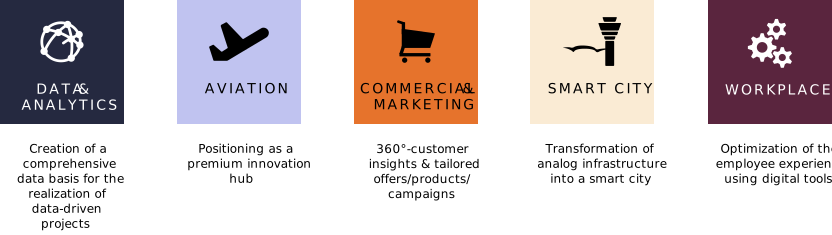
Innovation management should systematically promote the innovation culture in the company and support the implementation of the corresponding projects. Focal points here include new services and products that contribute to Munich Airport’s economic success and strengthen its competitiveness.
Munich Airport has introduced a standardized process to this end and entered into strategic partnerships for this purpose. Various cross-departmental sources and initiatives are used to identify and analyze relevant market and technology trends together with experts from the specialist departments. The goal is to provide a structure for recognizing trends that offer Munich Airport potential to innovate and to derive and test development opportunities for new products and services.
Prognos, Zukunftsatlas 2025, p. 3
IATA, Air Cargo Market Analysis, October 29, 2025