Our business units: a sustainable contribution to success
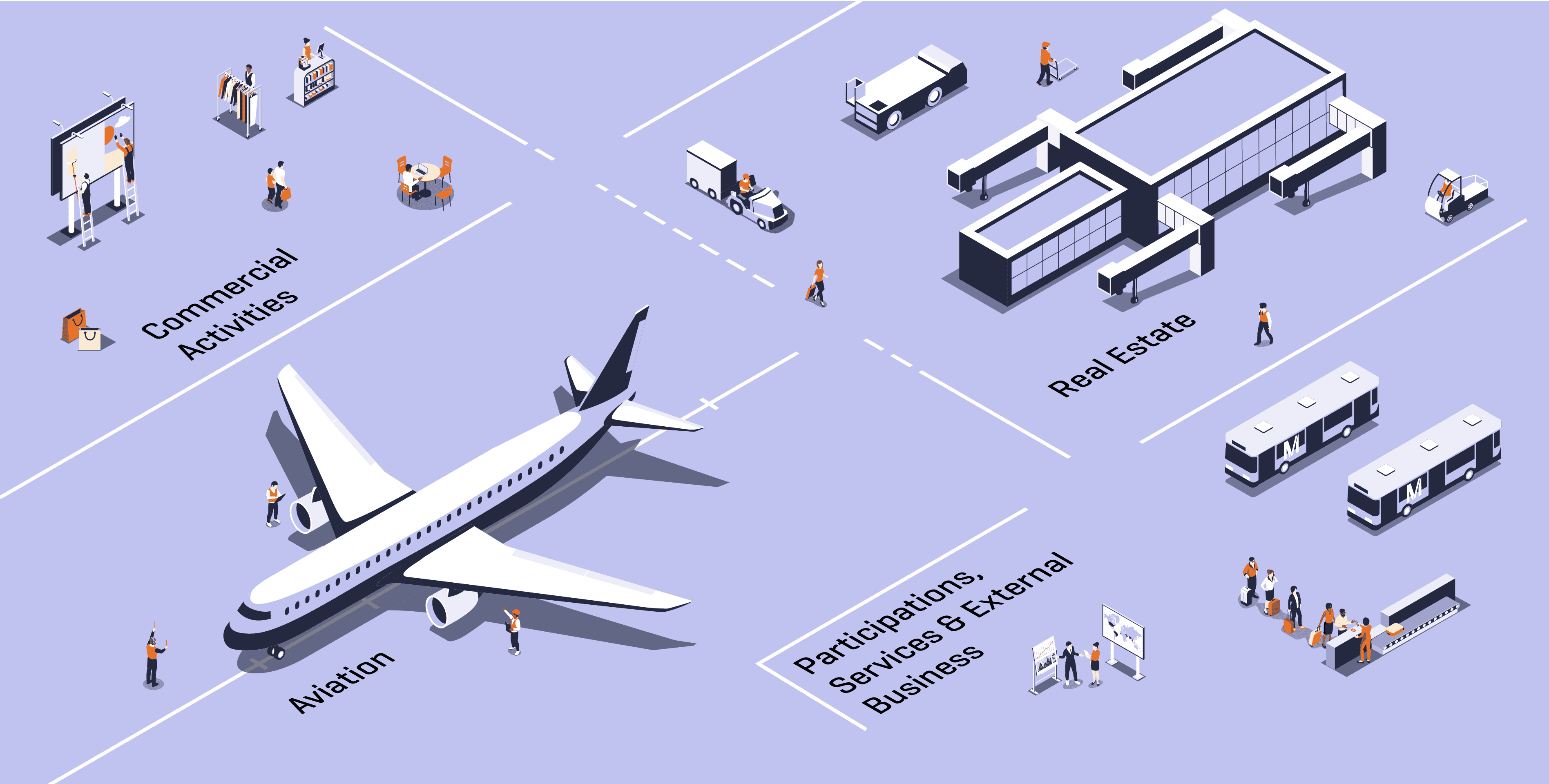
comprises the marketing and management of the airport’s commercial spaces and is responsible for parking services, the management of advertising partnerships, and the events business. The unit generates revenue from a broad range of commercial activities and contributes to enhancing the overall airport experience. The Group’s subsidiaries Allresto and eurotrade, operating as tenants and concessionaires, provide the retail and food & beverage offerings available at Munich Airport.
is responsible for the development, management, and commercialization of the Group’s real estate portfolio and land holdings, some of which are located outside the airport campus. In addition to ensuring the long-term preservation of the property portfolio, the unit manages land acquisition for future expansion projects and oversees the strategic direction of the Group’s real estate activities.
represents the core business unit of Munich Airport and encompasses all activities associated with the safe, efficient, and regulatory-compliant handling of air traffic. The segment provides and markets the infrastructure, facilities, and operational services required by airline customers and passengers, thereby ensuring the seamless functioning of airport operations.
comprises a broad portfolio of aviation-related services, including aircraft, passenger, and cargo handling operations on both the airside and landside. The unit also provides security and inspection services as well as relocation, operational readiness and airport transfer (ORAT), management, and terminal operations services for airports worldwide.
Aviation Summary
Munich Airport ensures connectivity for the population and companies in the region. Due to the economic strength and attractiveness of Bavaria as well as southern Germany, stable development in demand for air traffic can also be expected in the future. As a central European hub airport, Munich Airport plays a key role in this context.
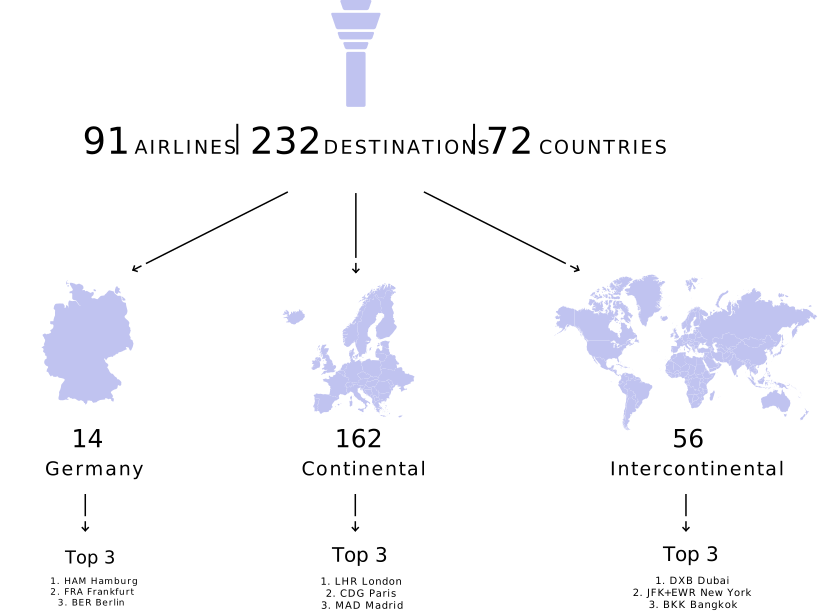
In 2025, the airport recorded growth of over four percent with 43.4 million passengers. This corresponds to an increase of approximately 1.8 million passengers compared to the previous year and represents the largest absolute increase in passenger figures of all German airports. Traffic volume thus reached around 91 percent of the level prior to the outbreak of the coronavirus pandemic. Of the remaining 4.5 million passengers compared to the record year 2019, 3.5 million are attributable to domestic German traffic. Particularly encouraging was the development of long-haul traffic in 2025. With 8.9 million passengers, it was around 9 percent above the previous year’s level and reached 105 percent of the pre-crisis level. New long-haul connections made a significant contribution to this growth – including the launch of the route to Hong Kong by Cathay Pacific as well as new destinations such as Calgary, Orlando, and Windhoek, which are served by Discover Airlines. Since mid-December, daily flights by Air Arabia to Sharjah have also complemented the extensive offering to the Gulf region.
Long-haul routes and connecting traffic will continue to form the strategic focus of traffic development in the future. With 35 based long-haul aircraft, the Lufthansa Group will have more long-haul capacity in Munich during the summer flight schedule 2026 than ever before, including, for the first time, two Airbus A330 aircraft operated by its tourism subsidiary Discover Airlines. This underlines the importance of the Munich location within the airline group’s multi-hub system. In addition, continental point-to-point traffic expands the route network, including new connections by easyJet to Rome and Bristol.
Airfreight also benefited from the expanded long-haul offering. Cargo volume increased by ten percent year-on-year in 2025 to around 340,000 tons and is therefore above the level of 2019. The very positive development in the cargo and logistics sector highlights, on the one hand, the central importance of functioning global supply chains and, on the other hand, clearly demonstrates the economic significance of the airport for the region and beyond.
Commercial Activities Summary
The Commercial Activities business unit makes a significant contribution to the value creation of FMG. The optimization of space utilization and the further development of the product portfolio play a central role in increasing willingness to purchase among target groups. Changes in retail and consumer behavior require new marketing and acquisition strategies, such as the use of digital tools and the targeted approach to air passengers as well as visitors through campaigns and partnerships. The positive development in passenger figures in 2025 is reflected in the retail and gastronomy sector at Munich Airport, with an increase in revenue of 4.3 percent compared to 2024. The parking and mobility segment also recorded revenue growth of 4.5 percent compared to the previous year period, particularly driven by individual transport in leisure travel. Ongoing renovation measures and new construction projects ensure the future availability of parking capacity. Occupancy and pricing of parking offerings are optimized through online marketing and targeted yield management. In advertising, the focus was on strengthening existing brand partnerships, acquiring new customers, and marketing advertising spaces, including in connection with major events and trade fairs in Munich. Since 2025, there has been a cooperation with the airports in Vienna International Airport and Zurich Airport for the joint marketing of advertising campaigns along the entire travel route.
Additional momentum and positive feedback were generated by the multi-week major summer event held in the MAC Forum. In the coming years, further events are planned for the summer, offering a special stay experience for travelers as well as for visitors.
Real Estate Summary
The Real Estate (RE) business unit is responsible for the needs-based planning, provision, and further development of buildings, spaces, and infrastructure to ensure the operational performance of the airport and to support the companies located at the site. In addition, the unit pursues a strategic positioning of the real estate portfolio on the market with the aim of unlocking additional value creation potential and establishing Munich Airport as a competitive and attractive real estate location in the long term. Against the backdrop of a predominantly long-used real estate portfolio, there is a comprehensive need for revitalization across the entire portfolio. Renovation measures, modernization, and the sustainable preservation of the building fabric therefore represent a central focus of the real estate strategy over the coming decade. Particular attention is paid to measures aimed at increasing sustainability and improving the overall visitor experience and service quality for passengers and customers, as exemplified by the new Terminal 1 pier. In the coming years, further extensive renovation measures and modernization projects are planned. These include, among others, Terminal 1 and the central building, the tower, as well as the parking garages, and make a significant contribution to preserving the substance, ensuring operational stability, and securing the future viability of the airport infrastructure.
We maintain an active dialogue with the region and take its interests into account both in site development and in construction projects. We assume responsibility for infrastructure projects beyond the airport premises and support companies that seek to leverage proximity to the airport and the international environment in their location decisions. Upper Bavaria is one of the economically strongest regions in Europe and is characterized by a broadly diversified industry structure. In addition to industrial and technology companies, the sectors of aerospace, automotive, semiconductors, life sciences, as well as research and higher education are particularly prominent.
As a high-performance hub airport in European air traffic, Bavaria also positions itself as a «gateway to the world» – with a positive leverage effect on the real estate sector at and around Munich Airport. International connectivity, reliable access, and a high level of service quality create an environment that promotes investment and supports the establishment of globally connected companies. In this way, we contribute to value creation in the region and to the future-oriented positioning of the Munich Airport real estate location.
Participations, Services & External Business Summary
Among the Group’s principal subsidiaries, alongside AeroGround, is Munich Airport International GmbH (MAI). This subsidiary supports the strategic growth of FMG beyond the Munich location. By developing new business units, MAI contributes to the diversification of the Group. The company offers management, consultancy, and training services for the international aviation sector and – also due to the recognized quality of Munich Airport – is regarded as a reliable and valued partner worldwide.
Terminal A at Newark Liberty International Airport (EWR) celebrated its second anniversary in 2025. The building is operated by Munich Airport International GmbH (MAI) and its subsidiary Munich Airport NJ LLC (MANJ) and has already received multiple awards.
Material projects worldwide
As the terminal operator of Terminal A in Newark, NJ, MAI, through its subsidiary Munich Airport NJ, is responsible for the full operational management, including airport processes, service quality, concessions, as well as compliance matters and the coordination of all stakeholders.
As the ORAT partner for the JFK New Terminal One, MAI supports the project in all phases of operational preparation and commissioning. The MAI team manages planning, trials, stakeholder readiness, and transition processes and ensures that the international terminal operates safely, in an integrated manner, and efficiently from the first day of operations.
As the ORAT partner in the Toronto Pearson «LIFT» program, MAI supports the Greater Toronto Airports Authority (GTAA) in the operational preparation and commissioning of new terminals and terminal areas during the multi-year redevelopment phases. The MAI team plans and coordinates trials, stakeholder readiness, and transition processes to ensure that each new area can be operated stably, safely, and efficiently from day one.
At A. N. R. Robinson International Airport in Tobago, MAI supported the planning and implementation of an ORAT program for a newly constructed terminal as part of a consulting project.
In West African Guinea, MAI, together with amd.sigma, is carrying out a consulting project for the capital’s airport in Conakry, covering master planning, terminal design, and traffic forecasts.
Doncaster Sheffield Airport was closed in 2022 and is now set to reopen under a new operator. MAI is providing consulting services to prepare the commissioning of the airport.
Since April 2021, the consortium SOF Connect, a subsidiary of the French investment fund MERIDIAM, has been operating Sofia Airport. SOF Connect is specifically working on the further development and optimization of traffic development at the Bulgarian capital’s airport. Key projects include expanding connections and renovating and extending the passenger terminal. In this context, MAI provides long-term management, consultancy, and training services across all areas — from planning through to airport operations.
The ORAT project acquired in 2024 has been successfully continued. MAI supports Navi Mumbai International Airport Limited, a subsidiary of Adani Airports Holding, in preparing for the opening of Mumbai’s new second international airport. Partial opening took place at the end of 2025.
Since 2022, MAI experts, together with the subsidiary amd.sigma, have been supporting the planning and conceptual design of the new U-Tapao International Airport, approximately 160 km southwest of Bangkok.
Together with colleagues from amd.sigma, MAI is supporting the modernization of the existing airport through design reviews, both in the terminal area and on the apron. The project was acquired in 2023 and has an expected duration of five years.